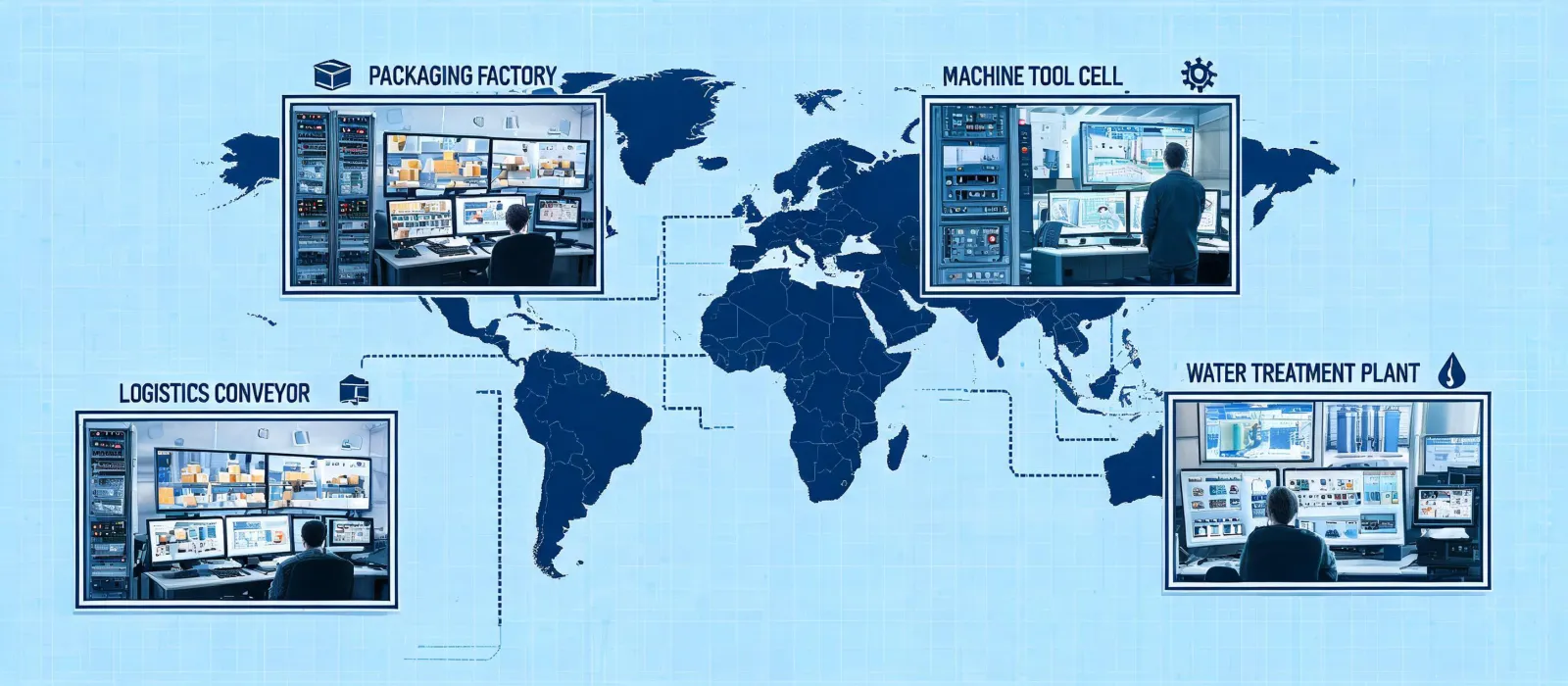
Map of industrial PLC application environments

Applications organized by control risk

Mitsubishi Plc across connected production environments

The same controller family can face very different scan, network, motion, safety and environmental demands. Application context determines which specifications deserve priority.

Control priorities by operating region

Packaging, assembly and machine tools

Sequence-heavy machines require an I/O schedule tied to sensor response, actuator timing, high-speed counters and servo coordination. An FX-series or other compact architecture can reduce panel space, while rack-based control may provide more expansion and specialized motion capability.

Program capacity and nominal scan time do not alone establish performance. Network traffic, interrupts, special instructions and HMI polling must be tested with the actual application.

Water, HVAC and facility systems

Distributed pumps, analog instruments and remote panels shift attention toward communication distance, isolation, surge exposure and service access. Modbus TCP or serial links may integrate existing field devices, but gateway mapping adds configuration and diagnostic responsibility.

Ingress protection belongs to the enclosure and installed assembly, not merely the PLC module. Temperature, condensation and contamination limits must be checked against the exact manual.

Conveying, warehousing and handling

Long conveyor zones benefit from distributed I/O that reduces home-run wiring, while centralized I/O can simplify network dependency and common troubleshooting. The decision balances cable distance, update time, cabinet locations and the consequence of a network interruption.

Safe stopping functions require a separately validated safety architecture. A standard PLC should not be represented as a safety controller unless the exact hardware, software and application meet the relevant requirements.

Architecture review

Decision weight before model selection

These bars show review emphasis rather than measured product performance.

I/O electrical fitFirst gate
Program and scan demandExecution gate
Networks and motionIntegration gate
Environment and documentsRelease gate

Centralized or distributed I/O?

Centralized wiring can simplify network fault domains and place maintenance in one cabinet, but long field runs increase copper and installation effort. Distributed I/O shortens field wiring and supports modular equipment, while requiring a resilient network design and local environmental protection.

Native protocol or gateway?

A native interface can reduce components and expose richer diagnostics. A gateway may preserve proven field devices and phased migration, but creates another firmware, mapping and failure point. Neither route is universally superior; update rate, data model and maintenance capability decide.

Map the application before choosing the rack

Provide the process sequence, I/O schedule, motion axes, network peers, enclosure conditions and downtime constraints. A useful response will distinguish verified inputs from assumptions and identify which model-specific manuals remain necessary.

  • Rated voltage and current by module
  • Program memory and scan demand
  • Modbus TCP, EtherNet/IP or PROFINET integration
  • DIN rail, panel space and IP enclosure conditions